
Comrade Vonnegut
A Book Review +1

I thought I knew a lot about Kurt Vonnegut, but I didn’t know how big he was in the USSR. In a new academic study of culture during the Cold War, Sarah D. Phillips has released a detailed book from Bloomsbury Press, titled Kurt Vonnegut in the USSR, which was released in February. Her book tells the story of Rita Rait, the Russian translator who was given the job of translating Vonnegut’s work in 1970. (Her full name was Rita Rait Kovalyova.) Her first job was translating Salinger’s Catcher in the Rye in 1957. That book, according to Phillips, sold out at 350,000 copies when it appeared in Foreign Literature (Inostrannaya Literature) magazine, a very popular Russian periodical.
Rait was a person of exceptional ability. She was fluent in Russian, English, French, and German. Despite her father’s belief in her medical potential, she was initially more drawn to language and literature than to science and anatomy when she began her medical studies. So, she studied medicine by day, language and literature by night. By the end of the twenties, she had ingratiated herself into Moscow’s literary circle. According to Phillips “she had a feel for interpretation and genre” that went deeper than just subbing a Russian word for an English one. She could capture the core meaning and true essence of a sentence by translating an author’s thoughts from one language to another while maintaining the core message of the writer. Her skill lay in conveying not just the words, but the fundamental message and themes of an author’s work from one language to another.
Tough job, especially during the Brezhnev regime in the seventies. Rait had to work under the careful eye of government officials who controlled all messaging that was against or contrary to party policy. She walked a fine line between honest translation and Russian politics.
Publishing in the USSR in the seventies was guided by the policies of the Communist Party, of which Rait was not a member. She was required by law to look for and omit anything critical of the Soviet system, and anything that had to do with morality, such as vulgar language, violence, and sex. Rait called the latter “Victorian chastity.” Phillips describes the Soviet censorship process in depth, noting, “The most desirable foreign book, in the USSR’s view, was one that Soviet readers would demand.” It also had to be a book that, with minimal shaving and tweaking, was politically acceptable ... a lot of Vonnegut’s writing fit all these criteria.”
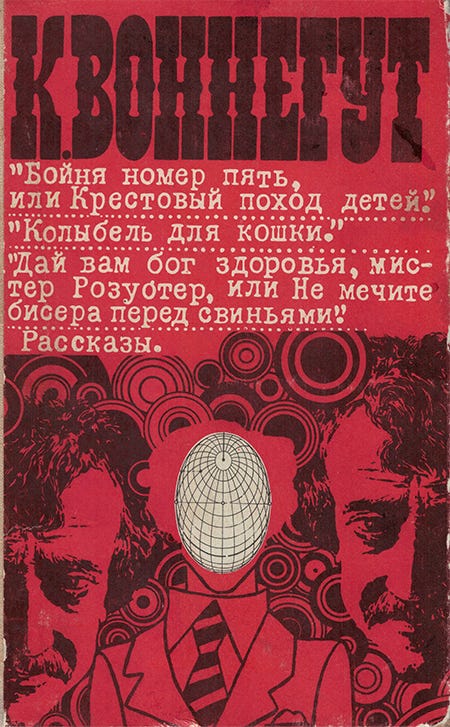
So, by 1978 Rait had successfully translated three Vonnegut novels: Cat’s Cradle, Breakfast of Champions, God Bless You, Mr. Rosewater, and the play, Happy Birthday Wanda June. These works alone were enormous hits with a generation of Russian youth, eager to read, consider, and discuss Vonnegut’s work. His appeal in Russian was the same as it was in English: a sardonic style, with humour, sarcasm, and the element of science fiction. His books captured moral debates that offered Russian readers a kind of escape from the slugishness of their culture in the seventies. Vonnegut provided relief from Soviet dogma because his books “spoke directly to their own lives and experiences.” Phillips says that high school and university students read Vonnegut’s novels. She says they were in the sciences, technical intelligentsia as it were. They loved his stories of technology going wrong, the humanity of his characters, and his slant on science fiction.
In fact, Vonnegut’s Soviet readers were broad in scope: scientists, professors, engineers, teachers, et al, loved his work. Phillips interviewed thirteen Vonnegut fans for her study. According to his readers, his books were deemed very entertaining, and receiving abundant praise, particularly from young readers eager for Western literature.
Rait translated, with heavy censorship, Slaughterhouse 5, which was added to a 727-page, single-volume of four novels that came out in 1978. It sold 50,000 copies and was even used as barter for the services of plumbers or electricians when people had no cash. The hope of an open country that Khruschev dreamed of, only tightened when Brezhnev came to power in the early sixties. The Soviet Union, as it was renamed by Lenin, became a cold, rationed, stale country under Brezhnev, that had little pulp to produce books, yet somehow Vonnegut’s works were in circulation, even if in limited print runs.
Then, in 1974, Vonnegut traveled to Moscow and met Rita Rait. He wasn’t alone. He was under constant surveillance by the KGB. Phillips reproduces a translated version of agent Kudriavtseva’s report. It makes for good, classic Cold War spying banality. Vonnegut and Rait then corresponded by letter and the occasional phone call. Their friendship ended in 1988 when she died at 90.
It’s an amazing story of the subversive power of the written word. Phillips doesn’t lament on this key idea very long. Her book is all about the extensive research she did in its preparation. The narrative is driven by facts, yet her conversational style isn’t burdened by them. She takes pleasure in narrating the account of Rita Rait and her contribution to Russian culture amidst its stagnation. There was a time when American writers believed in literary diplomacy between states, even if it was just a dream.
Here’s a full interview with Phillips upon the release of her fascinating book.
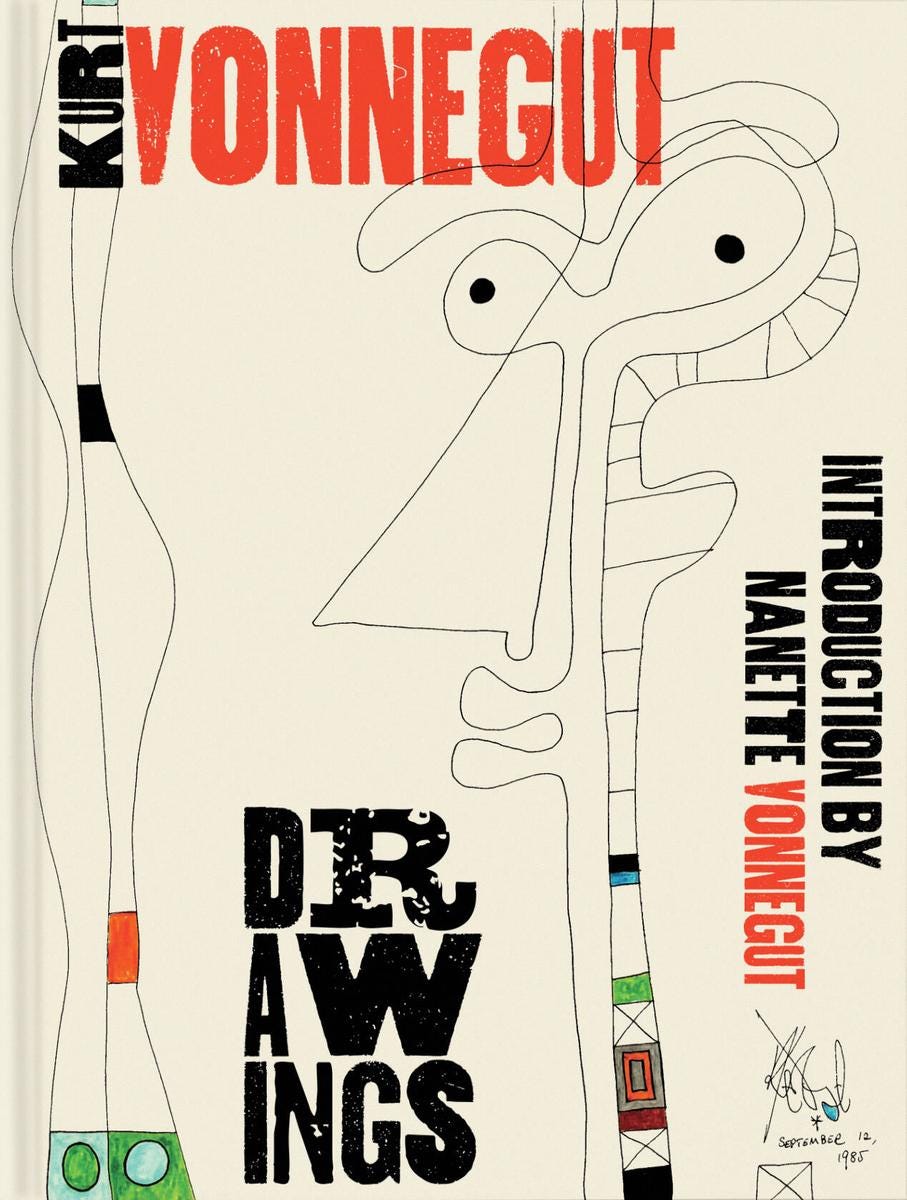
Kurt Vonnegut Drawings (Monacelli)
A fine companion to the Phillips book is Kurt Vonnegut: Drawings, released on April 9th. This is a new edition that originally came out in 2014 by Phaidon Press.
It’s a curated collection of Vonnegut’s “doodles” but it’s much more than the simple drawings he added to some of his novels. This collection features his artwork from the eighties, when writing became a chore and drawing came more easily to him. The book features an introductory essay by Nanette Vonnegut, Kurt’s youngest daughter, who was born in 1954. It’s followed by a critical essay by friend and art critic Peter Reed, who met Vonnegut in 1972. The book reproduces images that were first drawn on heavy paper or Bristol board measuring up to 26 inches by 19 inches. Vonnegut used felt-tipped pen and thick magic markers for colouring. Self-portraits are included as well as line drawings, objects, and portraits of women. As he put it, “that’s how we go through life, reading faces very quickly,” which explains why most of the images are of faces.
It delves into Vonnegut’s visual inclinations, a characteristic rooted in his lineage, as his father and grandfather were also artists. Nanette makes a point of this in her introduction. She is a self-described “printmaker” who switched to oil painting in 2020 during the pandemic.
Besides her father’s talent, she addresses the recurring question of what it was like to live with her renowned father. Her answer, “it was like living with an elephant for 15 years that was trying to give birth to something twice its size.” She remembers her father “disappearing into a forbidden part of the house called ‘the study.’” This is where he wrote using a typewriter, where the author was heard “Rat-a-tat-tat,” putting his “big thoughts on small pieces of paper.”
By leafing through Drawings, I reached a clearer understanding and appreciation of Kurt Vonnegut, artist (and author.) His visual work is full of humour, grace, character, and humanity. It’s a beautiful tome.